Showing posts with label visions of paradise. Show all posts

Friday, October 16, 2026

The kingdom of heaven is like a wardrobe door

The kingdom of heaven is like a wardrobe door. Its presence is simple, humble, and ignored. Once seen, once opened, it leads to unimaginable beauty and unexpected depth. There are temptations which can corrupt us and turn us into the worst versions of ourselves, and dangers to challenge us and transform us into great warriors or great healers, kings and queens of an otherworldly realm. It is best known by those who enter with the spirit of a child. 

(The Lion, The Witch, and the Wardrobe by C.S. Lewis was originally published on October 16, 1950. It was the first-published volume of The Chronicles of Narnia.)

Sunday, May 24, 2020

Toward a Theology of Beauty (Aesthetics) in Worship

When I read the descriptions of the ancient Jewish tabernacle, then the descriptions of the later Temple, I have a growing realization of the sensuality of our worship tradition. It is full sights: the fine embroidery in rich colors, the woodwork, the gold inlay, the careful shapes and proportions. It is full of scents: incense, and paneling of sweet-scented wood. It has a feel: water for washing. It has tastes: even then, bread and wine. This is a faith which embraces the world and recognizes its goodness. More than that, it takes the elements of the world and displays them as gems to reveal the creator's goodness. It patterns the earth's elements to reflect a transcendent heaven.

I've always been particularly struck by the description of the lamp stand: gold in the shape of an almond tree or branch, with almond flowers. When lit, I imagine that it looked like a tree of gold with flowers of flame. That is a sight that could have mesmerized, could have coaxed even the hardest soul to believe that there is good in the world, undeniably right before their eyes.

This beauty is not for judging; it is not merely for admiring. Worship is a participation, a self-inclusion in celebrating the eternal beauty. We recognize the presence of God in the beauty of the world.

Monday, November 22, 2010

Seven Wonders of the Ancient World - and a problem with the modern world

The modern world has its own wonders. But they are very different from the wonders of the ancient world. The modern world has created wonders of invention, of efficiency, of communication, and of discovery. But, unlike the ancients, we have no wonders of beauty. Even an ancient wonder like the pyramid -- some in our cynical age might call it a monument to the ego of a tyrant -- even it has a beauty and symmetry that stands the test of time. I once read a description of the ancient pyramids in the days before centuries of looters; they were covered with white stone and capped with gold. They were beautiful. The hanging gardens of Babylon, again one of the wonders of the ancient world, was not only a marvel of engineering in its day, it was also an earthly paradise.

The ancient wonders highlight some things that our world has lost, things that our age does not value. There is little intent to create beauty, little respect even for the thought of it. And one distinguishing mark of the wonders of the ancient world was exactly a sense of wonder -- that is, these things were created to be marveled at, to bring delight or awe or even a sense of the holy and transcendent into this world. Our "wonders" are entirely secular wonders, or to be more exact, wonders produced by a world that only recognizes the secular as valid. When was the last time our world's cultures produced a work of true beauty, a wonder in the ancient sense?

As the vision of paradise fades from the minds of men, the intentional beauty fades from the things we create. One of the most obvious marks of secularism is a kind of desert in the culture.

Some people speak of a zeitgeist, a spirit of the age. Just as it is possible for a person to have a personality that is not well-rounded, I think the zeitgeist of secularism -- the spirit of our age -- has a very one-sided personality, one that is efficient but has forgotten warmth, beauty, and kindness. For anyone interested in psychology, I wonder: is the zeitgeist, that spirit of our times, effectively the same thing as our superego, the voice of our conscience? If so, then a distorted spirit of the age leads directly to the same thing being echoed on down through each personality in the age, and being transmitted as the new normal to the next generation.

It remains for us, then, who find our times to be shallow and cynical to do something about that. It remains for us, who are uncomfortably squeezed by the narrow and bitter spirit of our times, to stake a claim in our age for kindness and decency, for beauty, for holiness, for paradise, and for wonder. These are the echoes of Eden, these are the things that have been systematically chased out of our age, and these are the things of the kingdom of heaven on earth. People find it very easy to scoff at religion in an age where all the people -- even Christians -- go along with the cesspool of cynicism that is modern news and politics, the routine fraud and injustice in government and economics, the institutionalized mediocrity that is education. The job falls to us to create lasting families and deep friendships that are the stuff our world is starved for, to re-create the concept of fellowship in our age, and to re-introduce the holy and the beautiful into this world.

"Prepare the way for the Lord" -- it is our job to make every valley exalted, and every mountain bowed down, to make straight in this desert a highway for our God. John the Baptist did not build literal roads; he built a spirit of readiness for God.

Friday, September 03, 2010

On being like God (3): creativity and righteousness

Everyone has an ethical system. Everyone makes decisions based on what they think is good and right. Even those who claim that morality and ethics are meaningless go right on every day making judgment calls based on a value system.

Every system of ethics -- every different thing we might value -- leads us to have certain role models, certain people who are living examples of what is good and right, to the best of their ability. I don't mention this to promote a person or group and designate them as having pride of place; I mention it to see what kinds of role models you might get from different ways of thinking about right and wrong. Would the most upright people be the ethics police, those who enforce and uphold the rules? How about the ethics instructors who teach the others? What about people who live ethically (by the rules) more often than others?

But on a view of walking after God, the craftsmen and skilled artists are worthy role models because they increase the objective amount of good in this world that is worthy of loving. The heroes of the Bible include skilled craftsmen; here we find records of acts of worship such as making embroidery and carvings, sculpture and incense. Writing the stories of the people of God was a holy act; writing songs for worship was a holy act. Playing a musical instrument was a holy act.

Those who recognize God as creator, and us the image of God, have gone to great lengths to devise new musical instruments, new art, new literature, new songs. When God created, he saw that it was good. One of the greatest things we do, acting in his image, is to also increase the good in this world by creating something of beauty.


On September 2, 1973, Professor J.R.R. Tolkien died to this world and was born to eternal life. "Memory eternal!" as they say in the East.

Thursday, January 01, 2009

Handel: Scripture is a symphony

I was reading today that Handel's Messiah is now banned from public performances in China (h/t Ancient Hebrew Poetry), along with other sacred music. Apparently Messiah had been performed in China before, and was very well received. Handel's music is amazing -- and I'm not just saying that because he was Lutheran. (Beethoven considered Handel the greatest composer of all time -- which is no small compliment considering Beethoven is also a serious contender for the title of greatest composer of all time.)

The reason I bring up Handel is because I think he was, like J.S. Bach, primarily a theologian, and one who understood Scripture better than most of the systematic theologians. He did understand the basics of liturgy: that Scripture is not just for analyzing, but for praying and for singing. A musician and a poet notices things that an analyst does not: that the Psalms were originally for singing and are still best appreciated when sung, that the prophecies were originally announcements and are still best understood when proclaimed, that the imagery and symbolism of Scripture is more similar to a fugue with deep, hidden themes than it is to a textbook. And then there is that section of the book of Revelation where Handel noticed that it was an endless chorus of different voices exclaiming, "Hallelujah!" (I would rate Messiah's grand finale piece as the best Bible study ever written on the book of Revelation, and every other study of Revelation as merely preparatory to enable people to appreciate and participate in that grand finale.)

Handel knew that, rightly understood, Scripture does not cause only analysis but ultimately it causes celebration. Rightly preached, the Word of God does not cause people to dedicate themselves to analyzing the Scriptures, but to go out into the world celebrating the glory of God. Handel the theologian did not write traditional Bible studies or traditional systematic theologies; he wrote symphonies -- not on the view that they were lower than analysis, but on the view that praise is the ultimate fruit of understanding what God has done.

Sunday, October 14, 2007

Is there a sacred/secular divide?

The sacred/secular divide that we hear about so often is a thing that exists only as a result of sin. In a world without sin, whether we think of Eden or of the world to come, everything is filled with the glory of God, and there is no "secular." The earth is holy. Again, when Christ was in the world bodily, the kingdom of heaven was breaking in and the divide between the sacred and secular was breaking down. Sin and disease and hard-heartedness struggled for existence in the face of God's presence.

One call we Christians have in this world is to carry God's presence with us wherever we go, not as a hidden presence but as a redeeming presence. We know what God's presence does because we saw it in Christ: welcoming sinners and seeking out the outcasts, binding up the brokenhearted, comforting the afflicted but troubling the self-righteous and the complacent. God's presence welcomes the stranger, it creates brothers and sisters for us all, and it shows us a face by which we will know we are home. By love it creates a place where people gather for the hope that someone there will hear them, someone there will know them, someone there will call them by name and treasure them.

The sacred/secular divide breaks down whenever we dare to really know another person.

Sunday, August 13, 2006

Participating in Paradise: For the Glory of God


Photo credit: thanks to LutheranChik (gardener and bloomblogger among other things), a photo of phlox, used by her kind permission.

Creating a vision of paradise is not reserved for the likes of J.R.R. Tolkien or C.S. Lewis. All kinds of people participate in bringing paradise to their corner of the world. Gardeners -- and bloombloggers -- do what they can to demonstrate the beauty of God in the world. Cooks do what they can to re-create the feast of paradise. Needleworkers and painters and artists of all types recognize the paradise hidden in various places in the world. Home decorating, gardening, cooking -- at their best, all show evidence of the human hunger for paradise. And a quiet place where someone offers gladness, love and acceptance is a paradise of its own sort. God's act of creation is the inspiration for our own acts of creation. Our desire for beauty is desire for God, and for paradise is for fellowship with God.

Over the past few posts in this series I've mentioned some of the famous figures of our culture -- great artists and authors -- who have shown us a vision of paradise. To some extent, these people earned their reputation precisely because they have shown us paradise. It takes a soul of depth and breadth, along with mastery of the artistic medium, to make a believable and desirable paradise against the backdrop of some of the dark realities of this world. Some see the vision of paradise as escapism, others as nourishment. At any rate, it is refusing to let those dark realities dominate our minds and dispel our hopes; it is refusing to let those dark realities dominate the world in which we live. For the rest of us, our homespun attempts at paradise are modest enough. But they are a small measure of Eden, a foretaste of the feast to come and a measure now of the fellowship we will share. These expressions of paradise in our lives are living extensions of our faith and hope. Seeing paradise awakens love for God and for each other and in turn expresses this love again. It sustains us through difficult times. We each participate in some way with our own lives.

As a closing thought, I'd suggest that one reason the Christian authors, artists, and musicians have been among the most creative in the world is that the vision of paradise is completely at home in Christian studies, Christian thought, and Christian hope. This same vision of paradise has spread further throughout the world because of these masters of their craft, and more desire for paradise has been opened up in other lands. It is a legitimate way to let our light shine before the world so that people may see our good works and glorify our Father in heaven. "Good works" is usually taken to mean morally good, and "morally good" is often restricted to the dry ground of being ethically praiseworthy. But considering Christian artwork opens up new territory, more fertile and creative ground, on our "good work" causing others to glorify God. As C.S. Lewis once said he thought before his conversion to Christianity, he'd rather read Christian authors: they may be wrong (he thought at the time), but everyone else is boring.


This is the final post of the Visions of Paradise series. Starting next Sunday I will begin a series on moderns in our culture who commit their lives to service to the needy, showing the Kingdom of God on earth through compassion to the fallen. This is for people like myself struggling hard to find a way to grow in service. While I will not make much of the point in the future series, there is a connection between the visions of paradise and service. The vision of paradise is bringing God home to a corner of the world where paradise triumphs; it follows God's lead in creation. The work of service is bringing God home to a corner of the world where paradise has all but disappeared; it is following Christ's lead in redemption.

Previous in the Visions of Paradise series:
Children's Literature: C.S. Lewis' Narnia; F.H. Burnett's Secret Garden
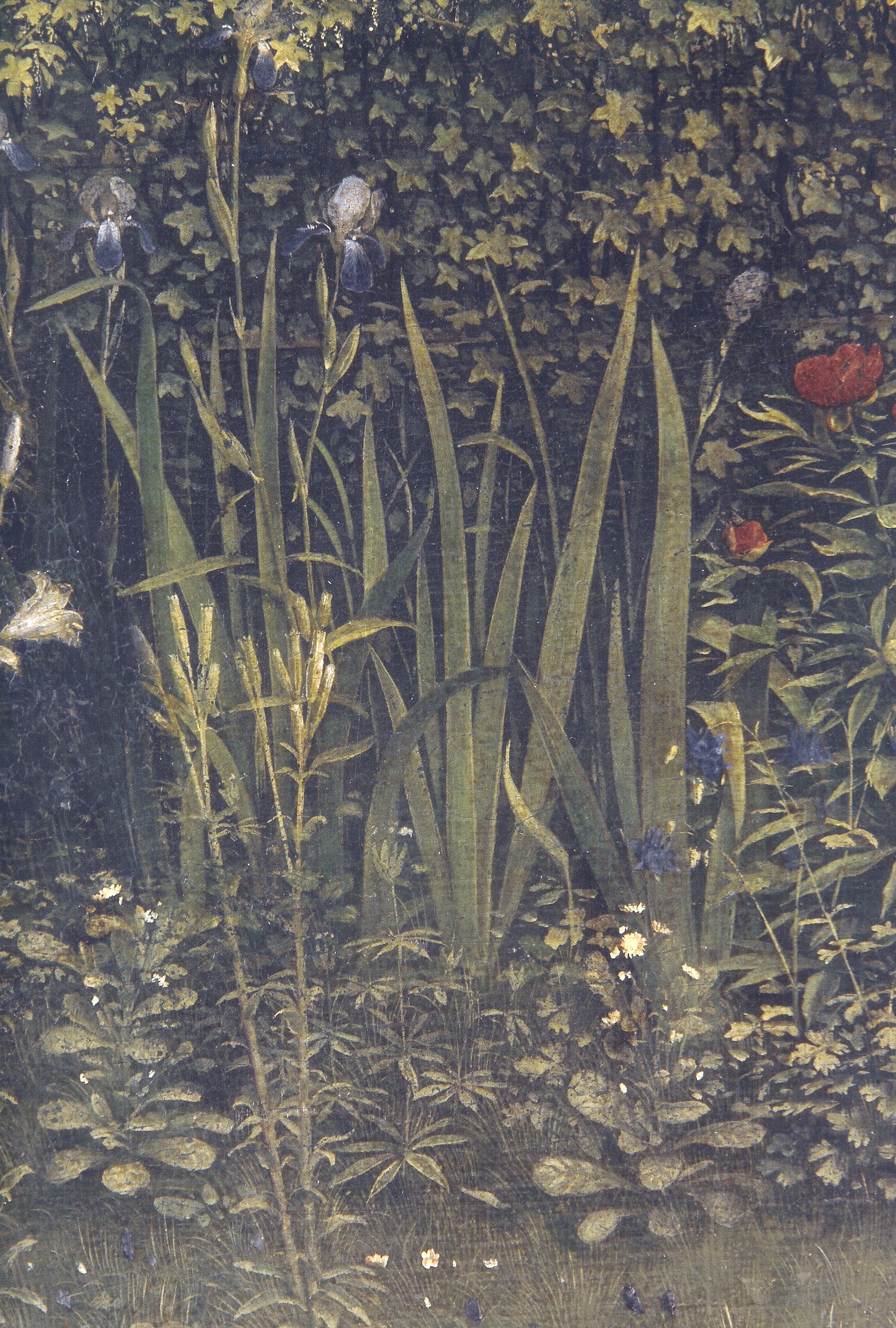
Van Eyck's Ghent Altarpiece
Tolkien's Lothlorien
Coleridge's Xanadu

Related:
Sacred Art Established Under the Sinai Covenant

Sunday, August 06, 2006

Paradise in Children's Stories: Lewis and Burnett

If the vision of paradise awakens desire, then successfully creating a vision of paradise ensures a place amongst the classics.

C.S. Lewis' Chronicles of Narnia offers a wide variety of glimpses of paradise, from the creation of a new world to a midwinter dance involving snowballs to a dazzling underground abyss growing live gems at the bottom of the world. This glimpse of paradise is from The Voyage of the Dawn Treader beyond the sea to the edge of the world, but here on an island not quite yet at the world's end.
"I am a star at rest, my daughter," answered Ramandu. "When I set for the last time, decrepit and old beyond all that you can reckon, I was carried to this island. I am not so old now as I was then. Every morning a bird brings me a fire-berry from the valleys in the Sun, and each fire-berry takes away a little of my age. And when I have become as young as the child that was born yesterday, then I shall take my rising again (for we are at earth's eastern rim) and once more tread the great dance."
F. H. Burnett's The Secret Garden is an exercise in paradise to itself, even if a little overdone for today's tastes. Though the garden itself is so enchanting that I can hardly read it without wanting to pick up my gardening tools, it also does an excellent job of picking up on the motif of the feast of paradise.
The morning that Dickon -- after they had been enjoying themselves in the garden for about two hours -- went behind a big rosebush and brought forth two tin pails and revealed that one was full of rich new milk with cream on the top of it, and that the other held cottage-made currant buns folded in a clean blue and white napkin, buns so carefully tucked in that they were still hot, there was a riot of surprised joyfulness. ... Roasted eggs were a previously unknown luxury and very hot potatoes with salt and fresh butter were fit for a woodland king ...


Previous in the Visions of Paradise series:
Van Eyck's Ghent Altarpiece
Tolkien's Lothlorien
Coleridge's Xanadu

Sunday, July 30, 2006

Visions of Paradise: Van Eyck

From the Ghent Altarpiece, Jan van Eyck, completed 1432 A.D.

Not all image-smiths work in words. Van Eyck's artwork has been said to sacramentalize nature, to remove (or refuse to recognize) a distinction between this world and the realm of the holy. He shows nature as a rightful part of God's self-revelation, and remembers that paradise was not meant to be an other-worldly thing.


Previous in the Visions of Paradise series:
Tolkien's Lothlorien
Coleridge's Xanadu

Sunday, July 23, 2006

Visions of Paradise: Tolkien

The others cast themselves down upon the fragrant grass, but Frodo stood awhile still lost in wonder. It seemed to him that he had stepped through a high window that looked on a vanished world. A light was upon it for which his language had no name. All that he saw was shapely, but the shapes seemed at once clear cut, as if they had been first conceived and drawn at the uncovering of his eyes, and ancient as if they had endured for ever. He saw no colour but those he knew, gold and white and blue and green, but they were fresh and poignant, as if he had at that moment first perceived them and made for them names new and wonderful. In winter here no heart could mourn for summer or spring. No blemish or sickness or deformity could be seen in anything that grew upon the earth. On the land of Lorien there was no stain.


Previous in the Visions of Paradise series:
Coleridge's Xanadu

Sunday, July 16, 2006

Visions of Paradise: Coleridge

For awhile during this season of Pentecost, I'll be reviewing visions of paradise on Sundays. For this series, the defining character of a vision of paradise is to arouse desire for the holy.


In Xanadu did Kubla Khan
A stateley pleasure-dome decree;
Where Alph, the sacred river, ran
Through caverns measureless to man
Down to a sunless sea.
So twice five miles of fertile ground
With walls and towers were girdled round:
And there were gardens bright with sinuous rills,
Where blossomed many an incense-bearing tree;
And here were forests ancient as the hills,
Enfolding sunny spots of greenery.