Showing posts with label beauty and art. Show all posts

Sunday, May 04, 2025

Whatever is worthy of praise, think on these things

In this world, there is an element of wonder and awe, the sense of possibility, an invitation to playfulness. One of my most-cherished artists is a street artist named David Zinn. For the most part, he's a street artist / chalk artist who specializes in adding a touch of fun to public spaces. Here is a piece he did that is part street art and part homage to M.C. Escher: 


If anyone could use a moment of delight in the goodness of the world, thinking on things that are worthy of praise, I find David Zinn's art to be worthy of consideration. 

Sunday, December 29, 2024

A moment for beauty

In this peaceful weekend between Christmas and New Year's, I'd like to share some artwork. In this case I am not the artist; these are AI-generated images. Neither is the inspiration mine by way of the prompt, which was based (loosely) on the description of the lampstand in the Tabernacle of the ancient Hebrews. My only involvement was coaching the AI through prompts until it had something approximating the golden lampstand resembling an almond tree, with the flames in the place of the almond blossoms, as the master-craftsmen built thousands of years ago. 


Light has a unique beauty. It is said to be the first of God's creations, and an image of God himself. 

Take care & God bless


Sunday, March 14, 2021

The Value of Meditation

"Consider the lilies of the field." -- Jesus

"Whatever is good ... think on these things." -- St Paul

Passion flower: original in Inkscape, 2021.
It is roughly a year ago now that the pandemic gained enough traction to affect daily life. I still remember shortages of all kinds of food, shortages of tissues and toilet paper, even a week or two where the store had no milk -- until people figured that it made no sense to panic-buy something so perishable. Much of what happened at this time last year was driven by fear or its marathon-running cousin anxiety.

I found it was not the scarcity that made the days seem bleak so much as the long-running anxiety and confinement. I find not just wisdom but also healing in Jesus' instruction to consider the lilies of the field. The flower in the nearby drawing is called a passionflower or a maypop. As a rookie artist, this is the first time I have been able to do justice to a passionflower, though hardly the first time I have tried. "Not even Solomon in all his splendor" could match the beauty of the wild. It helps me to consider that the most valuable things in life do not come from prosperity or safety. Creation has mesmerizing beauties. The good shepherd leads us; this is one of those green pastures. He restores my soul.

That is the value of meditation. May I consider it as essential as sleep.

Wednesday, October 21, 2020

Think on these things

Whatever is lovely, excellent, or praiseworthy, think on these things ... 


Sunday, July 05, 2020

Communicating the Nature of God

Every now and then I have asked my readers' patience with my side pursuits, such as poetry or humor; this time it is art.

The Bible contains many beautiful images, and describes many beautiful things. One that I find particularly striking is the image of the lamp and stand from the ancient tabernacle:

"Make a lampstand out of pure gold and hammer it out, base and shaft, its flower-like cups, buds and blossoms shall be of one piece with it. Six branches are to extend from the side of the lampstand -- three on one side and three on the other." (Exodus 25:31-32)

If you continue reading the description of the original, you will see that this drawing is much simplified and takes some artistic license to "complete" the image with the simplifications; the original design is well beyond my current skill. Still the basic idea -- a tree of gold with flowers of fire -- has enchanted me and captivated me for many years now, and I am pleased to have a first draft.

I have noticed how often the Bible associates holiness with beauty, with an incarnated touch of numinous beauty that communicates the splendor of God. It is my hope that any place where God's beauty is shown and God's name is invoked becomes an outpost of holiness in this world. They say that there are mysteries of God which cannot be put into words. In which case, we can only convey them through things that are not words. Beauty can communicate the presence of God better than so much talk.

Monday, November 22, 2010

Seven Wonders of the Ancient World - and a problem with the modern world

The modern world has its own wonders. But they are very different from the wonders of the ancient world. The modern world has created wonders of invention, of efficiency, of communication, and of discovery. But, unlike the ancients, we have no wonders of beauty. Even an ancient wonder like the pyramid -- some in our cynical age might call it a monument to the ego of a tyrant -- even it has a beauty and symmetry that stands the test of time. I once read a description of the ancient pyramids in the days before centuries of looters; they were covered with white stone and capped with gold. They were beautiful. The hanging gardens of Babylon, again one of the wonders of the ancient world, was not only a marvel of engineering in its day, it was also an earthly paradise.

The ancient wonders highlight some things that our world has lost, things that our age does not value. There is little intent to create beauty, little respect even for the thought of it. And one distinguishing mark of the wonders of the ancient world was exactly a sense of wonder -- that is, these things were created to be marveled at, to bring delight or awe or even a sense of the holy and transcendent into this world. Our "wonders" are entirely secular wonders, or to be more exact, wonders produced by a world that only recognizes the secular as valid. When was the last time our world's cultures produced a work of true beauty, a wonder in the ancient sense?

As the vision of paradise fades from the minds of men, the intentional beauty fades from the things we create. One of the most obvious marks of secularism is a kind of desert in the culture.

Some people speak of a zeitgeist, a spirit of the age. Just as it is possible for a person to have a personality that is not well-rounded, I think the zeitgeist of secularism -- the spirit of our age -- has a very one-sided personality, one that is efficient but has forgotten warmth, beauty, and kindness. For anyone interested in psychology, I wonder: is the zeitgeist, that spirit of our times, effectively the same thing as our superego, the voice of our conscience? If so, then a distorted spirit of the age leads directly to the same thing being echoed on down through each personality in the age, and being transmitted as the new normal to the next generation.

It remains for us, then, who find our times to be shallow and cynical to do something about that. It remains for us, who are uncomfortably squeezed by the narrow and bitter spirit of our times, to stake a claim in our age for kindness and decency, for beauty, for holiness, for paradise, and for wonder. These are the echoes of Eden, these are the things that have been systematically chased out of our age, and these are the things of the kingdom of heaven on earth. People find it very easy to scoff at religion in an age where all the people -- even Christians -- go along with the cesspool of cynicism that is modern news and politics, the routine fraud and injustice in government and economics, the institutionalized mediocrity that is education. The job falls to us to create lasting families and deep friendships that are the stuff our world is starved for, to re-create the concept of fellowship in our age, and to re-introduce the holy and the beautiful into this world.

"Prepare the way for the Lord" -- it is our job to make every valley exalted, and every mountain bowed down, to make straight in this desert a highway for our God. John the Baptist did not build literal roads; he built a spirit of readiness for God.

Sunday, August 15, 2010

The Infinite God and the Book of Psalms

God is infinite. Limitless. Boundless.

This means that our best efforts to understand God will always fall short. It also means that it is always possible for us to grow in understanding. We cannot reach the limits of knowing God. Our human minds are not up to the job. All the world could be filled with books and still not have exhausted the mystery of God, or the love of God, or the mercy of God.

In the Bible, the Book of Psalms is a case in point. As a collection of poetry, the Book of Psalms has beauty and depth and richness. And even though it contains so many songs, it keeps sending out the call to "sing a new song". In a way, the Book of Psalms will never be complete. Technically, sure, it has so many psalms and that's all. In that sense it has been complete down through the ages. But nearly every day someone in the world writes a new song to praise God. They are living out the Bible just as surely as the one who feeds the hungry and visits his neighbor. The Bible is a living book because our God is a living God. God's mercies are new every morning; it follows that there is always something more.

Our hymnals have one thing right: the Psalms and the hymns we still sing are, in a very real sense, part of the same work.

Thursday, January 01, 2009

Handel: Scripture is a symphony

I was reading today that Handel's Messiah is now banned from public performances in China (h/t Ancient Hebrew Poetry), along with other sacred music. Apparently Messiah had been performed in China before, and was very well received. Handel's music is amazing -- and I'm not just saying that because he was Lutheran. (Beethoven considered Handel the greatest composer of all time -- which is no small compliment considering Beethoven is also a serious contender for the title of greatest composer of all time.)

The reason I bring up Handel is because I think he was, like J.S. Bach, primarily a theologian, and one who understood Scripture better than most of the systematic theologians. He did understand the basics of liturgy: that Scripture is not just for analyzing, but for praying and for singing. A musician and a poet notices things that an analyst does not: that the Psalms were originally for singing and are still best appreciated when sung, that the prophecies were originally announcements and are still best understood when proclaimed, that the imagery and symbolism of Scripture is more similar to a fugue with deep, hidden themes than it is to a textbook. And then there is that section of the book of Revelation where Handel noticed that it was an endless chorus of different voices exclaiming, "Hallelujah!" (I would rate Messiah's grand finale piece as the best Bible study ever written on the book of Revelation, and every other study of Revelation as merely preparatory to enable people to appreciate and participate in that grand finale.)

Handel knew that, rightly understood, Scripture does not cause only analysis but ultimately it causes celebration. Rightly preached, the Word of God does not cause people to dedicate themselves to analyzing the Scriptures, but to go out into the world celebrating the glory of God. Handel the theologian did not write traditional Bible studies or traditional systematic theologies; he wrote symphonies -- not on the view that they were lower than analysis, but on the view that praise is the ultimate fruit of understanding what God has done.

Thursday, July 17, 2008

Tolkien: Reality, Fantasy, and Awakening Desire

“I didn’t want it to be a fantasy. I wanted it to be a history.” – The Fellowship of the Ring special extended edition, dir. Peter Jackson, New Line Home Entertainment, Inc., 2002, cast commentary, comment by actor Sean Astin

“Isn’t this just the place everybody wants to have grown up?” – The Fellowship of the Ring special extended edition, dir. Peter Jackson, New Line Home Entertainment, Inc., 2002, cast commentary, comment on the Shire by actor Orlando Bloom
J.R.R. Tolkien was not content just to write a story. It was not enough for him that people should like his world, like his story, like his characters. It was not enough that we should admire or appreciate his world. In The Lord of the Rings, Tolkien did not set out merely to entertain; he set out to entice. He set out to awaken desire, to arouse longing. A reader hasn’t really understood Tolkien until he has wanted to go to the Shire, to visit Rivendell and Lothlorien, to see the great dwarf city of Dwarrowdelf in its day.

How far Tolkien succeeded in arousing desire is seen not only in the enduring popularity of the story, but in the unprecedented extent to which people want to make that world their own. An entire new genre of games – the modern fantasy role-playing games beginning with Dungeons and Dragons – began with fans of Tolkien who were not content to let the story be someone else’s story, the world someone else’s world. Tolkien succeeded in making us want those places as part of our lives, those friends as our friends, that quest as our quest.

Many authors are said to treat the themes of good and evil, and many authors do treat the subject of evil seriously and extensively. But relatively few treat the subject of good in any depth at all. Tolkien has one of the more deep and sustained focuses on goodness – and its desirability – in modern literature. He adeptly sidestepped shallowness, triteness, and (possibly worse) a dry, inorganic approach to good that renders it impossible to desire profoundly.

Tolkien also did a great piece of workmanship by making the most desirable parts of this fantasy world to be entirely natural. Magic appears in the story – but it is not what gives the world its allure. The Shire has no magic; it has little more than grass, sunshine, and friendship to commend it. The dwarven city of Dwarrowdelf was not made by one dwarf with a magical ring, but by a host of dwarves employing a great natural wonder: the ingenious craftsmanship of those who pour their hearts and souls into their work. The elven kingdoms’ greatest boasts are the forests, poetry and music, and the memory of ancient beauties. What we most desire in Middle Earth is already part of our own world. Neither is it beyond our grasp – we could live in the hillsides and carved mountain-halls if we chose. The humbler, still satisfying joys of sustained friendship and enduring accomplishment are still available to us.

So Tolkien has made his answer as to the value of this world, and of goodness. If we get to the end of Lord of the Rings and think, “I want to go on the ship to the Undying Lands,” then he has won us over.


Originally blogged at CADRE comments January 1, 2005.

Saturday, May 31, 2008

In memory of a great hymn-writer: 1919 - 2008

It was today that I learned of the death earlier this month of the man who had been my favorite living hymn-writer, Jaroslav Vajda (an American, though of immigrant stock). He had written or translated over 200 hymns at the time of his death. The hymns I loved best were the communion hymn Now the Silence and the benediction Go My Children With My Blessing. I might well mention that the communion hymn Now the Silence was written as a continuing hymn of sorts, where the touching, moving single verse of Now the Silence was to be sung at communion and the occasional hymn, Then the Glory, also a single verse to the same tune, was sung during the annual celebration of End Time. It left the powerful musical impression of Communion being a foretaste of the feast to come. Lest I infringe on copyright I'll only quote it in part, but I think the best farewell salute I could give to a hymn-writer is this: I know of no better hymn to commemorate any Christian's departure than the ones he wrote. In fact, I struggled with whether to quote Then the Glory or Go My Children, which I hope to select for my own funeral when the time comes.
Then the glory, Then the rest, Then the Sabbath peace unbroken
Then the garden, Then the throne, Then the crystal river flowing ...
It does go on and very beautifully, but it would be poor thanks to the man if I broke copyright in a memorial piece.

Thank you, Mr. Vajda.
And as they say to the east: Memory eternal!

Monday, April 14, 2008

Scenes from our front porch


This little beauty had been inside a chrysalis on the front porch. We had been watching it for at least a week now. On Saturday night the chrysalis became see-through; on Sunday the Monarch butterfly finally came out. We got several pictures before its wings dried enough for it to fly away. The chrysalis picture is one that I took; the emerged butterfly photo is courtesy of my daughter, who is quite the budding photographer.

Sunday, May 13, 2007

Why I Like Icons

I've always been an admirer of art. The icon pictured here hangs on my bedroom wall. I bought it at the local Eastern Orthodox church's annual festival a few years back. I have a couple of other small icons as well, beautiful icons of the creation.

Mark at Pseudo-Polymath has been discussing icons, among other things. Protestants have not disowned religious art completely, but religious art certainly holds a much smaller place in Protestantism. Each of the different major groups in Christianity have different artistic styles for devotional artwork. Protestants seem to specialize in pastel pastoral scenes. Roman Catholics tend to specialize in the bare-chest/heart revealed artwork. And here I will give the Eastern Orthodox their due, I think they do the best at sacred visual art. They show little interest in realism; the holy cannot be directly drawn so realism does not help in representing it. But icons have been made of nearly every major scene in the Bible, carefully crafted so each color, each hand position, each element of the picture carries theological weight. The various elements of the drawing have been discussed and studied and have taken traditional forms over the centuries. The traditional forms are well-developed so that if you see Peter in one icon, you can easily recognize Peter in the next icon, even when drawn by another artist in another nation in another century. This allows a tremendous community and rich tradition within the artwork that is not really available when each artist re-imagines what each person looks like or how each building might have looked. This standardization has freed the artist from decisions about such details and allowed the artist to focus on communicating the holy. Some of the Eastern Orthodox icons are breathtakingly beautiful. And the range and variety of icons available is extensive. If you had to find Protestant renditions of every major scene in the New Testament, it might take some time and still be incomplete; for those you did find, the representations of certain people might not be recognizable from one artist's conception to the next. If you had to find Eastern Orthodox renditions of every major scene in the New Testament or likely even the entire Bible (along with parables and picturesque sayings), you could contact any of the major carriers of icons and place your orders and hope you had enough wall space for them all. The breadth of material covered is impressive.

I'm aware of the objection that Eastern Orthodox icons show no innovation in style, that they do not allow the artist much range or freedom, that the basic forms and even the representation of certain scenes may not have changed for a thousand years. To me, that's almost like complaining that the Psalms are poems that rely heavily on standard themes and internal parallelism; that's half their charm and all of their claim to unity. It's what creates the artistic impression of belonging to a set, representing a single vision of the world where they communicate with each other, grow and build from each other, each forming the background to the next. The unbrokenness of the tradition and style across many nations and many centuries has been the key to creating that unique richness of the icon tradition.

Icons and Devotion
I find icons useful in devotions in the same way that visualizing a scene from Scripture can be useful in devotions. A good set of icons can easily serve as a Bible for someone who cannot read or who does not have a Bible immediately available. They can serve as a focus for pondering Scripture, for meditating, for prayer. The "prayer" part may make some people uncomfortable. On occasions when I look at an icon while praying, I'm certainly not praying to the icon; the icon is simply useful in helping me focus on prayer. Neither would I choose to look at an icon while praying every time that I pray. It's simply helpful, an aid to devotion. And when visiting sites around the confessional Lutheran blogroll, I notice a good number of other Lutherans showing their appreciation for Eastern Orthodox icons.

Icons and Veneration
I've been to Eastern Orthodox worship services where the icons are venerated. That is to say, a line forms and each person is expected to join a line and kiss the icon. As a visitor, I've always been free to pass. And looking in from the outside, it feels as if here the Eastern Orthodox may have crossed a line. It's not the line of idolatry; they do not honor the pictures in their own right, but as visually helpful stand-ins for the realities they represent. The icons are not idols and are not used as such. The reason that I dislike the veneration of icons has nothing to do with any suspicion of idolatry. No, the reason that I dislike the veneration of icons is that it takes something which probably should be an acceptable practice (someone honoring the memory of one of the apostles by venerating their icon) and turns it into a commended practice, something very close to obligatory. There is a suspicion among the Orthodox that those who do not use icons in some sense dishonor the Incarnation in which the Word of God condescended to become visible and therefore representable in art. While it is probably helpful to almost any Christian to see icons, it does not follow that it is helpful to everyone to venerate icons, less still that it should be required. And there is an unfortunate after-effect to the ancient disputes over the place of art in the Christian community. If a thing has been disputed and has fought for acceptance, it is common afterwards that this view sees itself as "defeating" the alternative. A view which once fought to be permissible, after earning its rightful place, now increasingly sees itself as mandatory and obligatory. That is the perception I have of Eastern Orthodox veneration of icons, of a practice whose hard-fought fight for acceptance has eventually been interpreted as a something close to a mandate.

Icons and the Church Universal
If you have ever been inside an Eastern Orthodox sanctuary, you will have seen that each church has a collection of icons from the large and prominently-displayed ones of Christ to less large but still prominent ones of the apostles and the holy family and John the Baptist, and on to other icons representing the prophets of Israel and other people who have a key place in the history of the church. In such a setting, it is far easier to remember that we are part of a larger community, that there is an unbroken chain from Abraham, from Moses and Isaiah and Jeremiah, through Christ, to Peter and James and John, and down to our age. It is easier to remember the whole sweep of church history, the great cloud of witnesses, the saints triumphant, when it is represented before your eyes with the exact point of calling it to mind. In such a setting it is much easier to recognize ourselves in living community with the church universal, in fellowship with the believers of all ages.

Saturday, December 09, 2006

Evangelism and the witness of beauty

We began by considering beauty's ability to communicate the message, "this is good." Beauty is a witness to the goodness of the one who caused it. Now we've come nearly full circle, considering how God's Word transforms us again into a Christlike spiritual beauty. I'd like to close with this thought: to the extent that our lives have been transformed into things of beauty -- of love, joy, peace, patience, kindness, gentleness, and self-control -- that is the extent to which we have some spiritual beauty. And that beauty created within us also communicates -- to the extent we permit it -- that God is good, that Christ is good. Our lives -- to the extent we permit it -- are witness to the goodness of the one who redeems us and loves us.

One of my old friends is fond of discussing Transcendental Signifiers, by which he means something like "things you can look at and know there is a God." It's a Sign of something that Transcends, a natural witness, a signpost to God. This is our call: to make our lives Transcendental Signifiers, a natural witness, a signpost to God, a testimony of his humility and love by way of our own. When we live the way Christ taught us, people can look at us and know that God is good.

Thursday, December 07, 2006

Beauty, the Word of God, and the nature of morality

Confucius spoke of the ideal man, one whose thoughts were moved only by the Odes, whose actions were moved only by the Odes, whose words were moved only by the Odes. The Odes can be thought of in an idealized way as an ancient poetry of primal beauty that reveals the right order of the world; this poetry, once planted in our hearts, would cause the actions to be of similarly pure beauty. Many of the Israelites considered the Torah in a similar way as a thing of exceptional beauty, and that likewise someone whose life was holy would be ordered around the Torah, moved when it moved, silent when it was silent, spoke what it spoke. As Confucius may have conceived of the Odes as a kind of Natural Law, so the Israelites thought of the Torah as an expression of Natural Law, which is to say an expression of God's character, as the beautiful law which could not be otherwise without lessening the world.

Christians recognize that archetypal Word of God as the power by which God made the world, the creative beauty which gave it shape. We recognize the same loving and creative force, the same Word of God embodied in Jesus of Nazareth; we recognize him by his embodiment as the one who was moved by the Torah, who spoke when it spoke and was silent when it was silent, who lived that life of beauty, holiness, peace, and power whose possibility was promised by the existence of the Word.

This archetype -- the Word of God which transforms us and makes us holy -- arouses great desire and longing in humanity. But so long as the Word of God was a book, or a half-forgotten Ode of surpassing beauty, it could do little more than arouse in us holy frustration. When the Word of God was embodied before our eyes as Jesus of Nazareth, we saw more clearly, remembered more completely, the hints of the things of God, things that had been half-known or half-forgotten, half-suspected or half-doubted. Beyond Jesus showing us the Word clearly, he also spoke that Word of God to us again. The Sermon on the Mount from the Blessings to the end, the sheep and the goats, the law of love, the greatest commands -- these are the ancient Word of God which set the world in order. These are the words that the listening poets have strained to catch. From creation, this is the Word of God that was spoken over the dust as we were made.

The true nature of morality, as the Living Word, the Christ, made clear, is a joyful and loving thing, reserving anger for those things that dam the River of Life and profane the Holy Name. The true essence of morality is a thing that naturally attracts us to itself. The tedium of laws was given because of our need, broken humanity's need to be confronted about all the selfish and spiteful ways in which we mistreat and demean each other and cheapen each others' lives. Life by the Spirit of God is not like this.
The fruit of the Spirit is love, joy, peace, patience, kindness, gentleness, and self-control. Against such things there is no law.

Tuesday, December 05, 2006

Beauty and the nature of spiritual development

What is spiritual development? In Christian terms, it is a soul becoming more Christlike: fully in the image of God, but humble and fully human. Christ's life continuously showed to humanity the signs of both the transcendence and the humble love of God. He lived a life where his words and actions were full of beauty of every type, from compassion to judgment to mercy to love.

Christ is the template that transforms our lives. To develop spiritually is to become more Christlike. The beauty of Christ's life reshapes our own.

Monday, December 04, 2006

Knowing the beauty of creation, knowing the character of God

How knowing the world and ourselves leads us to know the character of God and to anticipate the possibility of God's incarnation.
I am convinced that he asks us to love him with all our heart, mind, soul, and strength because that is how he loves us. I am convinced that he asks us to love our neighbors as ourselves because he loves us as himself.


To see the beauty in creation is to know that creation is good. But what does this tell us about the Creator? We can can only create what we can first imagine. If creation is good, then it follows that the Creator must be good in each of those ways, as great as the sum total of all of the different kinds of goodness we see. If creation is great, God must be greater, not because he left anything of himself unexpressed, but because he is the cause of the greatness, the source and origin of it all. The different kinds of goodness we see in creation must reflect the different kinds of goodness in the Creator: vastness and intricacy, precision and wisdom, power and gentleness, vibrant overflowing aliveness.

In this creation there is a type of creature, ourselves, who see the creation and experience gladness. Knowing creation causes gladness in us because of the good we see there. Our natural reactions to this goodness in creation are peacefulness, kindness, joyfulness, and love for what we see. It follows that knowing the Creator would cause more gladness in his presence because of his greater goodness: it would cause us greater peacefulness, kindness, joyfulness, and love. The glory of creation is cause for awe and wonder; the glory of God is cause for greater awe and wonder. These things are spiritual beauties: beauties that come from knowing and reflecting on the physical goodness that communicates the heart of God, the mind and soul and strength of God. I am convinced that he asks us to love him with all our heart, mind, soul, and strength because that is how he loves us. I am convinced that he asks us to love our neighbors as ourselves because he loves us as himself.

How can we know this? We can know it from Christ, and the same message is also communicated to the whole world from God's creation. If all the beauties of the world reflect God in some small measure, then what about these things of spiritual beauty, such as love? If the vastness of the stars explains the fact of God's vastness to us, then does our own love communicate to us the fact of God's own love? When we see these spiritual beauties in ourselves or others, are we seeing part of God's essential character? Would it even be possible for the creature to have a good trait (such as love) which the Creator did not have first and bring into being? So we know that awe and wonder belong to God, glory and honor belong to God, but also peacefulness belongs to God, kindness belongs to God, joyfulness belongs to God, and love belongs to God. The world could not be as it is if God lacked any of these things. We expect that the kindness and love that belong to God are greater than ours, and that his good will eclipses our own. This is cause for peace in us, and for hope. The hope is not only for his kindness; we also have cause for hope that his love may turn towards us as towards all he has made. Such a hope leads to joy.

Creation's declaration of God's goodness raises some questions. If God's goodness is reflected in some way in all the good things here, how much could God make himself present in the world, not only by proxy as it were in the things of creation, but as Himself? Would God's love cause him to be present in the world, and if so, how?

Humankind's reflection of spiritual beauties -- our capacity for love and kindness, for joy and creativity, for deliberation and benevolence -- these similarities to God -- these raise more pointed questions: why has God made a creature with that much of his image? Does he intend a higher kind of love than is possible towards rocks and trees, oceans and stars? If God is loving, does God intend fellowship with those he has made? Would he have made that possibility of fellowship, created creatures suitable to it, unless he had intended to fulfill that possibility? What if God made himself present in the world not only as creator and designer and soul whose greatness is communicated by it, but also as a participant in the life of the world? Would God ever take the form of a creature? Is there any creature more suited to house God's life in the world than humanity?

So the approach of knowing God through creation alone causes us to wonder: is God's incarnation possible? And if it were -- if God lived among us -- would we understand the mind of God that much better?

Sunday, December 03, 2006

The Experience of Beauty and Awe, and the Existence of God

When discussing reasons that people believe in God, it seems that beauty and awe are often neglected. I suspect this is because the reasons for believing in God are often drawn up as rationalistic arguments. This approach, while rational, often supposes that reason is the highest of our faculties and that the other human faculties are lesser and "irrational". While reason is undoubtedly useful -- and can even lead to knowledge and wisdom if rightly applied -- I'm skeptical whether reason is the highest of our faculties. I also dispute the idea that the other human faculties are "irrational" simply because they are not pure reason. Here I'd like to sketch out a claim (rather than an argument) from beauty and awe.

Let "beauty" be that which communicates goodness.

Let "awe" be that which communicates transcendence.

Then to experience beauty and awe is to know there is a God (a good which transcends the material).

When I say that beauty "communicates goodness," that is to say that beauty is a name we give when we see the quality of goodness. This quality, when we perceive it, shows itself to our minds as the thought, "This is good."

When I say that awe "communicates transcendence," that is to say that awe is the sense that reality goes far beyond what we see directly, that there is a meaning far beyond the material or formal limits that present themselves to us.

This is at the heart of much of the intuitive sense that there is a God. It is one of the simplest and most commonly felt of the natural reasons for the existence of God. Such topics are barely able to be articulated because words are not their native language. And by itself, it is an incomplete claim for the existence of God. There is not enough concreteness to fend off an attack by pure naturalism, other than by the deep and abiding sense that pure naturalism is missing what is greater. For concreteness, we rely (rightly, in my opinion) on other approaches.

But this primitive sense of beauty and awe is still vital, and is often neglected in current theology so shaped by the naturalistic worldview and by naturalistic assumptions about what topics are permitted. Over the next few posts I will consider various ways in which the primitive sense of beauty and wonder are at home in Christianity, and ways in which we can rightly incorporate them into our knowledge of God, our worship, our views of spiritual growth, and our witness.

Sunday, August 13, 2006

Participating in Paradise: For the Glory of God


Photo credit: thanks to LutheranChik (gardener and bloomblogger among other things), a photo of phlox, used by her kind permission.

Creating a vision of paradise is not reserved for the likes of J.R.R. Tolkien or C.S. Lewis. All kinds of people participate in bringing paradise to their corner of the world. Gardeners -- and bloombloggers -- do what they can to demonstrate the beauty of God in the world. Cooks do what they can to re-create the feast of paradise. Needleworkers and painters and artists of all types recognize the paradise hidden in various places in the world. Home decorating, gardening, cooking -- at their best, all show evidence of the human hunger for paradise. And a quiet place where someone offers gladness, love and acceptance is a paradise of its own sort. God's act of creation is the inspiration for our own acts of creation. Our desire for beauty is desire for God, and for paradise is for fellowship with God.

Over the past few posts in this series I've mentioned some of the famous figures of our culture -- great artists and authors -- who have shown us a vision of paradise. To some extent, these people earned their reputation precisely because they have shown us paradise. It takes a soul of depth and breadth, along with mastery of the artistic medium, to make a believable and desirable paradise against the backdrop of some of the dark realities of this world. Some see the vision of paradise as escapism, others as nourishment. At any rate, it is refusing to let those dark realities dominate our minds and dispel our hopes; it is refusing to let those dark realities dominate the world in which we live. For the rest of us, our homespun attempts at paradise are modest enough. But they are a small measure of Eden, a foretaste of the feast to come and a measure now of the fellowship we will share. These expressions of paradise in our lives are living extensions of our faith and hope. Seeing paradise awakens love for God and for each other and in turn expresses this love again. It sustains us through difficult times. We each participate in some way with our own lives.

As a closing thought, I'd suggest that one reason the Christian authors, artists, and musicians have been among the most creative in the world is that the vision of paradise is completely at home in Christian studies, Christian thought, and Christian hope. This same vision of paradise has spread further throughout the world because of these masters of their craft, and more desire for paradise has been opened up in other lands. It is a legitimate way to let our light shine before the world so that people may see our good works and glorify our Father in heaven. "Good works" is usually taken to mean morally good, and "morally good" is often restricted to the dry ground of being ethically praiseworthy. But considering Christian artwork opens up new territory, more fertile and creative ground, on our "good work" causing others to glorify God. As C.S. Lewis once said he thought before his conversion to Christianity, he'd rather read Christian authors: they may be wrong (he thought at the time), but everyone else is boring.


This is the final post of the Visions of Paradise series. Starting next Sunday I will begin a series on moderns in our culture who commit their lives to service to the needy, showing the Kingdom of God on earth through compassion to the fallen. This is for people like myself struggling hard to find a way to grow in service. While I will not make much of the point in the future series, there is a connection between the visions of paradise and service. The vision of paradise is bringing God home to a corner of the world where paradise triumphs; it follows God's lead in creation. The work of service is bringing God home to a corner of the world where paradise has all but disappeared; it is following Christ's lead in redemption.

Previous in the Visions of Paradise series:
Children's Literature: C.S. Lewis' Narnia; F.H. Burnett's Secret Garden
Van Eyck's Ghent Altarpiece
Tolkien's Lothlorien
Coleridge's Xanadu

Related:
Sacred Art Established Under the Sinai Covenant

Sunday, August 06, 2006

Paradise in Children's Stories: Lewis and Burnett

If the vision of paradise awakens desire, then successfully creating a vision of paradise ensures a place amongst the classics.

C.S. Lewis' Chronicles of Narnia offers a wide variety of glimpses of paradise, from the creation of a new world to a midwinter dance involving snowballs to a dazzling underground abyss growing live gems at the bottom of the world. This glimpse of paradise is from The Voyage of the Dawn Treader beyond the sea to the edge of the world, but here on an island not quite yet at the world's end.
"I am a star at rest, my daughter," answered Ramandu. "When I set for the last time, decrepit and old beyond all that you can reckon, I was carried to this island. I am not so old now as I was then. Every morning a bird brings me a fire-berry from the valleys in the Sun, and each fire-berry takes away a little of my age. And when I have become as young as the child that was born yesterday, then I shall take my rising again (for we are at earth's eastern rim) and once more tread the great dance."
F. H. Burnett's The Secret Garden is an exercise in paradise to itself, even if a little overdone for today's tastes. Though the garden itself is so enchanting that I can hardly read it without wanting to pick up my gardening tools, it also does an excellent job of picking up on the motif of the feast of paradise.
The morning that Dickon -- after they had been enjoying themselves in the garden for about two hours -- went behind a big rosebush and brought forth two tin pails and revealed that one was full of rich new milk with cream on the top of it, and that the other held cottage-made currant buns folded in a clean blue and white napkin, buns so carefully tucked in that they were still hot, there was a riot of surprised joyfulness. ... Roasted eggs were a previously unknown luxury and very hot potatoes with salt and fresh butter were fit for a woodland king ...


Previous in the Visions of Paradise series:
Van Eyck's Ghent Altarpiece
Tolkien's Lothlorien
Coleridge's Xanadu

Sunday, July 30, 2006

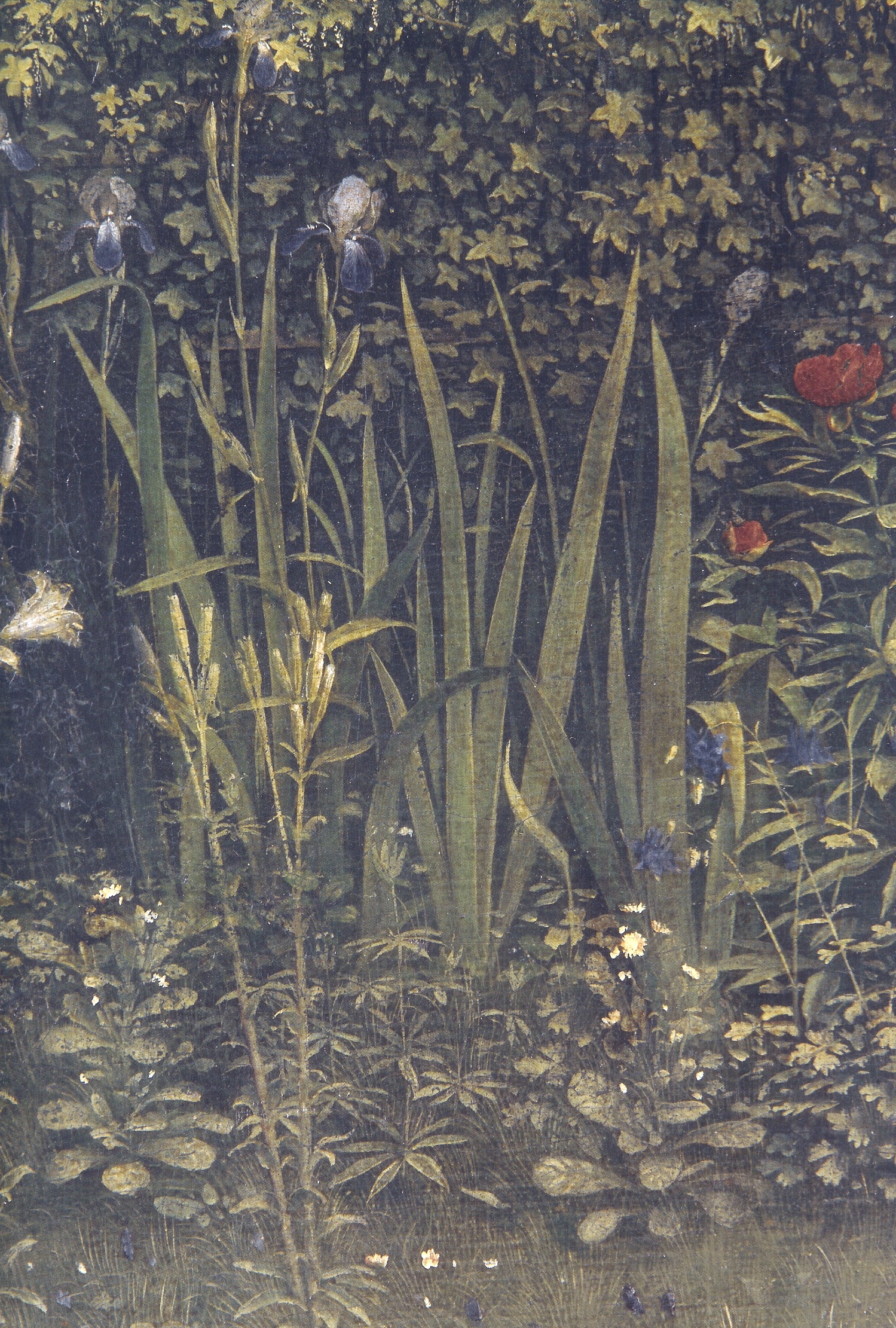
Visions of Paradise: Van Eyck

From the Ghent Altarpiece, Jan van Eyck, completed 1432 A.D.

Not all image-smiths work in words. Van Eyck's artwork has been said to sacramentalize nature, to remove (or refuse to recognize) a distinction between this world and the realm of the holy. He shows nature as a rightful part of God's self-revelation, and remembers that paradise was not meant to be an other-worldly thing.


Previous in the Visions of Paradise series:
Tolkien's Lothlorien
Coleridge's Xanadu