Showing posts with label calling or vocation. Show all posts

Sunday, January 25, 2026

Scott Adams' deathbed profession of faith

On the day of Scott Adams' death, he had arranged for a video to be released in which he professed his faith in Christ. 

From one perspective it was surprising: someone who for years had made no secret of his disbelief (antagonism?) toward faith was at the last minute saying that he accepted Jesus Christ as his Lord, at the urging of Christian friends to accept Christ before his death, and so he did. From another perspective it was calculated, and Adams gave voice to that: with a cost/benefit analysis like that, with such a risk/return ratio, it seemed to him worthwhile to profess faith at that time. It was a no-loss proposition. From another angle, it left the appearance of an investor timing his trade: sell stock in 'earth', buy stock in 'heaven'. What's a rational observer to make of all this? 

Minding our own business is a guideline that's worthwhile to keep. I won't be judging his actions, claiming to know his motives, or presuming to gauge his level of sincerity. Likewise, I think we have no business speculating on whether God accepted his profession of faith. God knows his heart and we don't. Neither is there any gain in pointing out sins; Adams has 100% of humanity for company there, and Christ teaches us to go easy on pointing out the sins of others unless we want to find ourselves similarly judged. My part is to bless God's name for creating Scott Adams, and to thank Scott Adams' memory for a career that was characterized by humor and insight. 

The thing that interests me is the timing of the profession of faith -- not because it's unique to Scott Adams' death, but because it's not. This is hardly the first deathbed conversion in history; I've met someone who has that in his pocket as a bucket-list plan. And to some extent the timing makes worldly sense: it's natural to value earthly things less when we can no longer hold onto them, and to value things of the spirit more when they're all we have left. 

And yet that's not quite the calculation we see in many deathbed conversions, Adams' included. Part of the reason people make that calculation on their deathbed is not simply that its urgency is undeniable; there can also be an assessment that we are unwilling to commit while we still have time left on earth. We see it even in professed Christians delaying when they are willing to give up a pet sin. We can postpone the moment when our faith affects our lives until it affects as little as possible. 

When we commit to Jesus as our Lord, we have to change. Humor has to lose its meanness. Sex has to be re-united with love and faithfulness. Affection has to be freed from self-interest. Service has to separate from self-promotion or influence-seeking. Achievement has to lose its one-upmanship. All kinds of things have to become more wholesome versions of themselves, but oh do we enjoy the alloys. And some things like fault-finding have to be given up altogether. We hesitate to commit because we love our sins, and would gladly postpone the moment when we admit what they are. So we convince ourselves that it's fine to be mean, unloving, self-seeking, self-promoting, and so forth, and the actual problem is that God wants us to love our neighbors. That can wait, we persuade ourselves. 

Is there any down-side risk to waiting to convert at the last minute? I believe that's the wrong ultimate question, but I'll mention my thoughts on it before moving on. Many people die unexpectedly; even a sincerely-planned future repentance might become a missed opportunity. And then, if the repentance is intentionally postponed for love of the sin, there is some risk that we aren't quite sincere, if we postpone until there is no earthly test remaining precisely because we would prefer to keep the fault. Best to admit that we're fond of -- even dependent on -- the faults that we use to make our lives more bearable, even if they tend to backfire. 

There is another cost of waiting til death is imminent to take hold of faith, which is walking through the whole of life without it. Postponing faith assumes it interferes with life instead of enriching it. But those who live most deeply in their faith find peace that passes understanding, and the unexpected gift of insight into the mind of God -- and the heart of God. The supposed burden that we avoid by waiting turns out to be loving God with heart, soul, mind, and strength, and loving our neighbors as ourselves. That is a goal that we could rationally, eagerly take up, worthy of a life-long pursuit. It is compatible with any honest and useful vocation. And it makes our lives more genuinely cherishable and worthy of savoring. 

If a deathbed conversion is the plan, if a deathbed confession is worthwhile, then a lifelong confession brings those blessings forward to redeem more of our lives. 

Sunday, October 15, 2017

How To Be a Furniture Salesman to the Glory of God

I've written before about what I believe is the biggest scandal in the church: the fact that, on most days, we don't live lives of such active compassion for others that it dwarfs the news that, yes, we fall short of our own ideals and are at times embarrassed by bad leadership. After Hurricane Harvey there was a huge shift, as people on the ground here in Houston know: there were countless thousands (I wonder did it cross over into 'millions'?) of Christians spending their days and resources helping in an organized way. Sure, there were some non-Christians who also showed compassion on people -- but the Christian community definitely shone brightly. It's still going on, though in quieter ways that don't really draw cameras: people still providing meals for people who lost their kitchens, or helping with the re-installation of sheet rock ...

The way that the media works, they pick one person to tell the story. During the height of the crisis in Houston, the news media chose Mattress Mack (real name Jim McIngvale), who is already well-known in the Houston area for furniture sales outlets, and even better known for giving back to the community cheerfully and generously. When the waters rose, he saw his fleet of trucks as rescue vehicles. With people needing a place to shelter, he saw his showrooms and warehouses as places with plenty of extra room and extra furniture where people could lay their heads, and sit down in a safe place. Because his heart is willing, he found the way.

We live in an age where we tend to delegate things to specialists. We are called to remember that living out our love is not for specialists, it's for all of us.

Friday, April 20, 2012

Walking after God: Noah and the animals

We've seen before how the ancient Israelites understood their duty to walk after God as a duty to imitate his good acts. They demonstrated a duty to visit the sick from God visiting Abraham after his circumcision; they demonstrated a duty to comfort the mourners from his blessing Isaac at the time of Abraham's death.

From the same line of reasoning, we could deduce an obligation to preserve all species of animals:
As the Almighty preserved every kind of animal on the ark, so do we also preserve every kind of animal.
I'm not here entering into the debate over whether certain animals were entered on modern "endangered" lists because of true preservation needs or merely in order to prevent construction. I'm saying that, regardless of the debate over whether any particular regulation was necessary for any particular species, based on the story of Noah and the ark we can still deduce that it is our duty to work with God to preserve all species.

Thursday, November 17, 2011

Youth worker succeeds beyond wildest dreams


Do we think of Christian calling too narrowly?

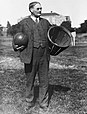
Back in 1891, a worker at the YMCA was given the job of developing an indoor sport that would use plenty of energy and prevent the students from becoming bad-tempered from inactivity during the long months of winter. In a modest way, it would improve the health and quality of life for those who participated. Isn't that a valid calling? The YMCA thought so. The assigned worker, James Naismith, thought so. Naismith had been an athlete in college and was gifted in sports. A valid calling is what makes the best use of our gifts and talents, isn't it?

Most charity groups run on a small budget, so that may have been why he chose the simple soccer ball and peach basket combination for his new indoor sport. The game quickly became very popular. The story has it that someone considered naming the game after its inventor, "Naismith ball", but Naismith wanted something to reflect the game itself: "basket ball".

Naismith probably could not have imagined the place basketball now has, not just in the U.S., but in the world. He lived to see his game included as an Olympic sport. I doubt, when he took his assignment to invent a new game, that he ever envisioned the wizardry of the Harlem Globetrotters or the artistry of Kobe Bryant, or the fact that every city park I have ever seen has basketball hoops.

A mission from God doesn't always mean preaching. If Naismith had tried to do that, he'd have missed his calling.

Thursday, June 23, 2011

What Bible verse are you?

"I was hungry, and you gave me something to eat ..." - Mother Theresa of Calcutta.

"Blessed are those who hunger and thirst for righteousness, for they shall be satisfied." - MLK

"Consider the lilies of the field." - Francis of Assissi

"Sing to the LORD a new song." - Charles Wesley, Amy Grant ...

I suspect that everybody has a verse, or a collection of verses, that really speak to them. The saints among us are those who follow that call of the Word of God.

If you think that being "born of again of the Word of God" is just a figure of speech, ask yourself this: Was Mother Theresa just an unusually good person, or was she an incarnation of the parable of the sheep and the goats? I believe that her spirit was born again when she heard the verses that called to her, and the word of God took root in her and lived.

I think most of us know the call of those verses that speak to us.

So I'm not kidding when I ask, "What Bible verse are you?"

Friday, February 11, 2011

On being like God (5), and index

Since the earlier series about being like God, I've noticed how many things I missed. Here are a few of them:
  • Those who establish righteousness and justice are walking after God, who gave the Ten Commandments to Israel.
  • Those who renew and restore are walking after God, who said, "Behold, I am making all things new."
  • Those who establish fellowship are walking after God, who called the twelve apostles, and who sent them out two by two.

Interesting that the verse about "walking after God" (Deuteronomy 13:4) cited in the Talmud on this topic can also be translated as "following God". I have to wonder if Jesus meant to allude to that when he called his disciples saying, "Follow me."

Previously:
Additions:

Thursday, January 20, 2011

What would better journalism look like?

Every once in awhile I wonder what various industries would look like if they were run according to Christian standards and principles. Recently I found myself wondering about journalism. It's difficult to get quality information on many subjects because you basically get either left-wing or right-wing political propaganda, depending on the news outlet. Sure, I try to keep up with the talking points of both sides, but the irritating thing is the debate stays really shallow, and there isn't a lot of in-depth coverage out there.

What would Christian news look like? It would speak the truth with love. It would also follow the wisdom of Solomon: "The first to present his case seems right until someone comes forward to question him." Both sides would be heard, and both sides would be questioned.

Let's take a hot-button topic, and I'll show you what I mean. Let's talk about the criminal justice system: the concerns over convicting the innocent or acquitting the guilty. The usual stances are: the left accuses the right of being too hard on criminals, being too gung-ho for justice, and risking convicting the innocent -- and, of course, racism. The right accuses the left of being too soft on criminals, being more pro-criminal-rights than pro-victim-rights, and acquitting the guilty.

What could a reporter do?

  • Calculate and publish the conviction percentages by judge. Check if there really is a difference in conviction rates between Judge(D) and Judge(R).
  • Is there a particular judge whose conviction rates are way out of line -- much higher or much lower -- compared to the others in the group? Spend some time in that courtroom and figure out why.
  • Check and publish mistrial rates.
  • Check and publish the plea bargain rates, and the typical differences in sentences.
  • Stay in the courthouse for a week or a month and take a survey after every acquittal. Pay the former defendants $20 each to tell you, anonymously, whether they were really innocent or guilty, to get a handle on the "acquitting the guilty" rate. If you're really feeling bold, ask them if their lawyer knew they were guilty before entering that "not guilty" plea, and ask them what factors enabled them to get away with it.
  • Check for overturned convictions or known cases of convictions later proved false. Research and write up the factors that led to the miscarriage of justice. If possible, get enough cases that patterns can be detected.
  • Interview the judges, prosecutors, public defenders, defendants, police, and victims about the different questions that come up during the background research.
Some would take financing; others would just take some good solid research. Ever seen a piece of reporting like that? I haven't. And that has a direct bearing on the quality of the political conversation. Fairly often it's the reporters who set the tone of political discussion in our country. The shallow and one-sided approach is poor stewardship of the public trust and of the public role of a reporter in our society.

Let's take just one more hot-button topic. Let's talk about illegal immigration -- or more specifically, the reporting on illegal immigration. The boilerplate stances are, on the left, that the poor from Mexico deserve a chance at the relative prosperity in America, that immigration enforcement and border security are just a cover for racism, and that the U.S. should provide a path to citizenship for those who enter the country illegally -- or from the right: that millions of illegal aliens are taking jobs that millions of Americans really need and adding a high burden of social service costs, and that the drug war in Mexico is too dangerous to leave our borders as they are. The reporting rarely gets deeper than that. That means it's not really reporting as such, it's more a matter of position papers being put out by the news affiliates of the two main political parties. People looking for real solutions are left without enough information.

What more could a serious investigative reporter find out?

Here are things that could probably be found with some background research. This first batch of items is limited to things where there are probably official statistics available, or that where statistics could be gleaned from existing sources with some effort. Because this first group of questions has to do with laws, statistics, and budgets, the subject matter is relatively limited, dealing with things that are covered by law or tracked by statistics.
  • How many people are in the country illegally?
  • How many jobs are held by people in the country illegally? What kinds of jobs? What are the typical hours in a work day? In a week? What is the typical pay? Who are the typical employers?
  • What are the typical living conditions?
  • Is there any estimate on what percentage of illegal residents have jobs that are intrinsically criminal (e.g. drug smuggling), what percentage have regular jobs, what percentage are day laborers, what percentage are unemployed?
  • How much money does the average illegal worker send back home to a dependent family in the average month or year?
  • Which public-funded service programs serve people regardless of citizenship or legal resident status?
  • How many publicly-funded students are in the country illegally? What percentage is that? What are the percentages on the high and low end of the spectrum for different neighborhoods, cities, counties, states? (Scope depends on the level at which the reporter works.)
  • How many illegal-resident students receive publicly-funded special services such as bilingual or ESL / ELL programs?
  • How many illegal-resident students receive free or reduced-price school lunches?
  • How many crimes are committed by people in the country illegally? Is there an estimate of the financial or human cost of the crimes?
  • As a percentage, how does the rate of criminals for illegal residents compare to that of citizens and legal residents?
  • How many people in the prison system are in the country illegally? What is the cost of incarceration? Who pays it? What percentage of the people in the system are in the country illegally?
  • Where does an illegal resident go to get health care? Who pays the bill?


After the basic statistics and background research had been done and the reporter has a clearer idea what to ask, they could start lining up interviews. I bet every one of my readers could think of good questions to ask. Here are types of people I'd expect would make good interviews:
  • Day workers
  • Illegal residents with regular permanent jobs
  • Employers
  • Apartment managers / landlords
  • Police
  • Immigration officials
  • Money transfer / wire transfer workers
  • Coyotes (professional people-smugglers) if available
  • School officials: admin; BIL/ESL workers
  • Hospitals, doctors' offices, local health officials


Here's the thing: if I sit around at a blog and can think of this, I know that a professional reporter could think of this, and better, if they tried. And it's not just these particular issues. Almost every issue of any depth could and should have someone do some serious reporting on it. The financial crisis, unemployment, recent frauds, an expose on how Congress really works ... all kinds of possibilities.

My point is not that a Christian would be (D) or (R); I think political point-scoring would be shunned as dirty pool by someone whose first priority is following Christ. A Christian approach to reporting would go beyond the slogans and canned talking points and get to the people really involved, with an eye to both love and justice.

Thursday, January 13, 2011

Ten Boom family: an iron resolve for kindness

Corrie ten Boom, her sister Betsie and their father Casper spent decades of their lives perfecting one thing that many of us never master: the art of being kind to all people, no matter what. Then came World War II; their beautiful Holland became Nazi-occupied Holland. When the occupying army began persecuting, even refusing food ration cards to Jews, their quest to be kind to all people -- no matter what -- was now a dangerous calling.

They faced questions they may never have imagined. What if keeping your neighbor fed and housed put you on the wrong side of the law? What if it put the police on your trail? What if you could be arrested for it? What if you could be placed in a Nazi concentration camp for it? Would your kindness stop, or would it stay with you in prison? Would there come a point when you cut your losses and stopped the kindness? Or would it transform the cells and barracks of the prisons where you were confined? Would it extend even to the prison guards?

Reading about their lives makes us understand: the reason the family succeeded in being so unfailingly kind in the early, peaceful part of their lives was not because it was easy. Theirs was not simply a kindness of convenience, a politeness of habit that could be interrupted by a break in the comfortable pattern of their lives. It was because they already possessed that iron determination that nothing could turn their path away from loving their neighbors. For us, even a disrupted schedule or an annoying neighbor can sometimes be too much for us and throw off our resolve to be kind. Their lives shine a spotlight onto our own lives: How determined are we to be the kind and welcoming face in this world?

Casper and Betsie ten Boom paid with their lives, dying in the concentration camps. Corrie survived to tell their tale.

Monday, January 10, 2011

J.R.R. Tolkien, Professor of Ancient Beauties

Professor Tolkien once said that a new word should be created, something that meant the opposite of a catastrophe, the opposite of a disaster. He wanted a word for when, against all odds, when all hope seemed lost, through an unexpected turn of events the good triumphed anyway. He suggested "eucatastrophe" for this word.

But Tolkien's work also leaves me searching for a word that I cannot find in our language. He is so determined to entice and allure with the goodness of the world, and the appeal is so strong and insistent, that the closest word I can find is "seduce". But "seduce" is always used of the appeal of bad things: the appeal of the bad is so strong that it corrupts our minds, our will, our character, and leads us down the wrong way to disaster. Tolkien has achieved what few others have done: he has shown the good in all its beauty and desirability, so that the appeal of the good is so strong and alluring that it un-corrupts our minds, our will, and our characters, and leads us down the right way towards health and sanity. When we have finished reading Tolkien, it seems genuinely unthinkable to lie or to betray a friend, or even speak too harshly with our neighbors. Aren't we supposed to be off somewhere helping to heal the world, or building a thing of beauty, or sitting with our friends and raising a toast?

Tolkien creates a world with layer on layer of history, each age leaving its own traces behind. Ancient poems in forgotten languages, hauntingly beautiful, are sprinkled through the pages. The landscape is scattered with the ruins of monuments of earlier ages. And the possibility is never quite gone: someone might take up those songs again, or take the empty throne again, and the crumbling ruins will then become the placeholders for rebuilding the glory that once was. The enchanting past never quite loses its sense of possibility, that it might have a living part to play in the future.

And so the good professor's works inevitably leave us with the impression that he was, after all, talking about this world. They leave us with a sense of unfinished business.

Professor Tolkien invites us to love what is good, what is just, what is pure, what is lovely, those things that are worthy of praise, and to think on these things.

Title for scholars:
Professor of Ancient Beauties

Other holders of the Tolkien chair:
C.S. Lewis
Samuel Taylor Coleridge

Monday, January 03, 2011

Mary of Bethany, Doctor of the Lilies of the Field

Some of the great saints of ages past have been reckoned "doctors" of the church. It seems to me that Mary of Bethany had a lot to teach. With that thought in mind ...


Of all the people of the New Testament, among the merely mortal, possibly my favorite is Mary of Bethany. The story has gone down in history about the day that Jesus went to Mary and Martha's house.1 Martha worked double-time to get everyone served. Mary just sat at Jesus' feet and listened. When Martha appealed to Jesus to press Mary into working, Jesus appealed to Martha to see the value of not worrying so much, and sitting and listening more.

Mary showed the way for friendly, joyful contemplatives -- not hermits, not recluses, not removed from daily life. She was devoted to treasuring up Jesus' words in the middle of her home and family.

I have heard many sermons over the years about Jesus' visit to Martha and Mary's home. They're usually about how Mary needed to learn to work, and Martha needed to learn to relax, in order that they both learn from each other and find the right balance. But Jesus said nothing of the sort. He didn't say a word about Mary becoming troubled about many things. We miss Jesus' point entirely if we insist on defending Martha's hectic stress; Jesus' words to her were far closer to an invitation to put all those worries aside. Jesus said Mary already had the better of it.

We rush to defend worries as "responsible" and a hectic schedule as "productive"; we rush to justify ourselves. Many people simply cannot let Mary be the good example in that story. Do we insist on Martha's right to her misplaced priorities? Otherwise our own might be challenged.

Mary is the living example of what Jesus said, "Seek first the kingdom of God." She found the kingdom of God in her living room. "Consider the lilies of the field. They do not toil or spin. And yet not even Solomon in all his splendor was arrayed like one of these."

We're embarrassed, determined not to be seen as silly by the world, so we do not actually consider the lilies of the field -- at least not very seriously. I think that Mary was not ashamed -- not after what Jesus said -- to take what he said seriously, and consider the lilies of the field.

But along the years there are those who have thought about what Jesus said to Mary, and have chosen what is better.

Titles for contemplatives:
Doctor of the Lilies of the Field
Scholar of the Rose

Other members of the order:
Francis of Assissi
Therese of Lisieux


1 - Luke 10:38-42

Monday, September 13, 2010

On being like God (4): Finale

Personal note: My schedule is clearing off so that I should be able to resume some of my earlier series this month. In particular, I've been eager to get back to 'divisions in the church', though those entries take awhile to develop.

For this final entry in the series on being like God, rather than get all explanatory -- I'm sure you have the point by now -- I wanted to approach it in a more prayerful and meditative way.

Great is parenting, for the Holy One chooses to be known as Our Father.
Great is marriage, for the Holy One calls himself a bridegroom and a husband.
Great is forgiveness, for God chose forgiveness in restoring the world.
Great is humility, for God chose to humble himself for the sake of love.
Great is love, for love moved God to act in compassion for his people.

So God calls for us to be like him in devoting ourselves to faithful and enduring love.

Friday, September 03, 2010

On being like God (3): creativity and righteousness

Everyone has an ethical system. Everyone makes decisions based on what they think is good and right. Even those who claim that morality and ethics are meaningless go right on every day making judgment calls based on a value system.

Every system of ethics -- every different thing we might value -- leads us to have certain role models, certain people who are living examples of what is good and right, to the best of their ability. I don't mention this to promote a person or group and designate them as having pride of place; I mention it to see what kinds of role models you might get from different ways of thinking about right and wrong. Would the most upright people be the ethics police, those who enforce and uphold the rules? How about the ethics instructors who teach the others? What about people who live ethically (by the rules) more often than others?

But on a view of walking after God, the craftsmen and skilled artists are worthy role models because they increase the objective amount of good in this world that is worthy of loving. The heroes of the Bible include skilled craftsmen; here we find records of acts of worship such as making embroidery and carvings, sculpture and incense. Writing the stories of the people of God was a holy act; writing songs for worship was a holy act. Playing a musical instrument was a holy act.

Those who recognize God as creator, and us the image of God, have gone to great lengths to devise new musical instruments, new art, new literature, new songs. When God created, he saw that it was good. One of the greatest things we do, acting in his image, is to also increase the good in this world by creating something of beauty.


On September 2, 1973, Professor J.R.R. Tolkien died to this world and was born to eternal life. "Memory eternal!" as they say in the East.

Sunday, August 29, 2010

On being like God (2)

Those who've known me for awhile already know: I like to trace things back to their roots. When it comes to the view that we should be like God, it has a long history ... and the Talmud takes it in an interesting direction. See if the thoughts here sound familiar to you:
But [the meaning of walking after the Lord your God is] to walk after the attributes of the Holy One, blessed be He. As He clothes the naked, for it is written: "And the Lord God made for Adam and for his wife coats of skin, and clothed them," (Gen 3:21) so do thou also clothe the naked. The Holy One, blessed be He, visited the sick, for it is written: "And the Lord appeared unto him by the oaks of Mamre," (Gen 18:1 ... while Abraham was recovering from surgery) so do thou also visit the sick. The Holy One, blessed be He, comforted mourners, for it is written: "And it came to pass after the death of Abraham, that God blessed Isaac his son," (Gen 25:11) so do thou also comfort mourners. The Holy one, blessed be He, buried the dead, for it is written: "And He buried him in the valley," (Deut 34:6) so do thou also bury the dead. (Sotah 14a).

The ground rules seem to be to copy an action of God that was described in the Torah. Several of the things described in this collection were already described centuries earlier by Jesus in the teaching the Last Judgment:
For I was hungry, and you fed me; I was thirsty, and you gave me drink:, I was a stranger, and you took me in: Naked, and you clothed me: I was sick, and you visited me; I was in prison, and you came unto me. (Matthew 25:35-36)

The Talmud was kind enough to trace the source of some of these as imitations of God: visiting the sick and clothing the naked.

Possible sources for the others are:
  • God fed the hungry: "Who fed you in the wilderness with manna" (Deut 8:16)
  • God gave drink to the thirsty: "who brought forth water out of the rock" (Deut 8:15)
  • God took in the stranger: "I have also established my covenant with them, to give them the land of Canaan, the land of their pilgrimage, wherein they were strangers." (Exodus 6:4)
  • God visited the prisoner: "But the LORD was with Joseph, and showed him mercy, and gave him favor in the sight of the keeper of the prison" (Gen 39:21)
That is to say, that it is possible that Jesus meant the teaching on the Last Judgment to recognize the principle to imitate God: to be merciful, as He is merciful.

Thursday, August 26, 2010

On being like God

Part of what it means to be human is to be like God. From the first mention of man in the Bible, before we are formed God has chosen to make us in the image of God, in the likeness of God. This is not an isolated passage, either; the theme continues throughout the whole of the Bible.

The Law of Moses calls the people to be holy because the LORD God is holy. It calls people to observe a day of peace and rest because God observed a day of peace and rest. God's actions establish a pattern for our actions; we acknowledge that imitation even in our calendars, which still recognize a seven-day week and a weekend.

Jesus calls us to be perfect because our Father in heaven is perfect, and to love both our friends and our enemies because God's love extends to all mankind, the just and the unjust, even to the evil. He tells a parable where the master's forgiveness should lead the servant to forgive as well. He even speaks of being born again of God's spirit, and becoming children of God. And Christ tells us that as he has loved us, so we are to love each other.*

John's letter also speaks of us being the children of God, and again that our character flows from God within us: God loves us first, and so we love each other.

In Paul's letters, he also echoes Christ on loving each other as God loves us, forgiving each other as God forgave us. He calls us to be imitators of God. It is not too bold or presumptuous to imitate God; in fact, it is part of what it means to be human. Regaining that image of God is a core part of our redemption.

The question, if we want to be like God, is then: What is God like?


* This goes beyond how we usually understand "What Would Jesus Do?" slogans. Those slogans picture us going about our daily lives and when a moral question comes up or when a temptation arises, then it calls us to ask ourselves "What would Jesus do?" But this kind of "bailout morality" would not call us to transform our work week into 7 days, or try to establish justice throughout the land. This "image of God" way of being like God does more than scratch the surface or guide us when we are unsure. It gives us a new direction for certainty, a new goal for transforming the structure of our lives, a new set of possibilities for how to pursue the good.

Sunday, August 15, 2010

The Infinite God and the Book of Psalms

God is infinite. Limitless. Boundless.

This means that our best efforts to understand God will always fall short. It also means that it is always possible for us to grow in understanding. We cannot reach the limits of knowing God. Our human minds are not up to the job. All the world could be filled with books and still not have exhausted the mystery of God, or the love of God, or the mercy of God.

In the Bible, the Book of Psalms is a case in point. As a collection of poetry, the Book of Psalms has beauty and depth and richness. And even though it contains so many songs, it keeps sending out the call to "sing a new song". In a way, the Book of Psalms will never be complete. Technically, sure, it has so many psalms and that's all. In that sense it has been complete down through the ages. But nearly every day someone in the world writes a new song to praise God. They are living out the Bible just as surely as the one who feeds the hungry and visits his neighbor. The Bible is a living book because our God is a living God. God's mercies are new every morning; it follows that there is always something more.

Our hymnals have one thing right: the Psalms and the hymns we still sing are, in a very real sense, part of the same work.

Saturday, January 30, 2010

Increase our love: lifting ideas from those better than me

In my quest to learn to love better, a note about Jesus' mother Mary opened my eyes to some other things around me.
Mary treasured up all these things, and pondered them in her heart. (Luke 2:19)
That's one thing love does: it replays scenes and events over and over in our hearts. It understands that another person as a treasure, and keeps polishing each memory to make sure it stays bright and unfaded. And I understood a few things in a different light.
  • My father used to photograph things to focus his own attention on what he loved, and to keep the memories.
  • A sister in Christ at church is a devoted scrap-booker. Her books are filled with her family. Again, a way to focus her attention, rehearse her love, and treasure memories in a tangible way.
  • I know someone who, not really artistic enough to scrap-book, has little biographies of her children's best moments in a Word document.
  • My grandmother, every time I saw her, would rehearse story after story of all the good in my grandfather. When it came time to write his eulogy, I realized that she had been praising the good in his life every time I heard her, not waiting until he died to praise his life. Much better for his sake, I'd think.
Some people may think these are very basic things to notice, but it's just because I have such a long way to go. I'd be curious if anyone had noticed other ways people rehearse their love and treasure their memories.

Sunday, June 01, 2008

Dr Seuss and the baptized imagination

Recently Ben Myers' blog mentioned a new book on Dr. Seuss' works as parables. This is not a review of that book, which I hope to read sometime; instead, here are my thoughts on how Dr. Seuss is easily distorted when people try to take a "deeper meaning" than joy and delight from his books.

Dr. Seuss' works definitely reflect his Christian faith. And he certainly wrote some books which were thinly-disguised morality works. Yertle the Turtle was one; Seuss' Lorax is probably the only environmentalist book that many people have ever read. How the Grinch Stole Christmas has a not-too-disguised look at how "Christmas, perhaps, means a little bit more." Grinch is probably the only of Seuss' moralistic books that is well-loved, and I suspect that is because the moralizing was less preachy.

It was a few months ago that I talked to a Very Earnest, Very Pious Christian woman on the subject of children's books; I brought up Dr. Seuss. When I told her about the Cat in the Hat and Green Eggs and Ham, I could see her turning up her nose. Did Seuss, she asked, ever write anything substantial? The implication was plain: the sheer gladness of life reflected in his other books was considered less Christian (in her view) than moralizing. I submit to you that moralizing is not only a noisy gong or a clanging cymbal in most peoples' ears, but that there is only one thing that can redeem moralizing from being just that: behind any true sense of good and evil is a much deeper kind of good: the good of the type found in Eden, not the good of rules but the good of existence and wonder, the delight in creation. This is what Seuss captured best of all. His odd creatures would have been at home in Eden. And any sense of right and wrong that is not to be a power-play must ultimately rest on the deeper and more profound type of good that is the goodness of life, the love of creation.

To Seuss, joy and delight are exactly what is substantial. Wonder and gladness are precisely the deeper meaning of those books, and those who look for Thou Shalts and Thou Shalt Nots as deeper and more profound than joy have forgotten what Eden looked like.

Sunday, January 13, 2008

John the Baptist, the tax collectors, and the soldiers: on a mission from God

Today's Sunday School lesson was on John the Baptist -- not on the baptism of Christ, but on preparing the way (Luke 3). Tax collectors and soldiers were among those who came to John to be baptized. He told the tax collectors not to collect more than required, told the soldiers not to extort money but to be content with their pay. He told all the people who had extra to share with those in need.

So here is the question I put to my Sunday School class: Of all the people we read about today (John the Baptist, all the people who came to him, the tax collectors, the soldiers), who was on a mission from God?

First answer out was of course John the Baptist. True, of course. But after the other people talked to John, they were on a mission from God too. They were sent into the world with instructions and a purpose that would change the world. (What, you don't think honest soldiers and tax collectors and repairmen would change the world? Then tell me where you live.)

We're all on a mission from God. Not to downplay John the Baptist or any preacher of the word: part of his mission from God was to help everyone else see their mission from God.

Monday, April 23, 2007

What if your profession had been named?

Tax collectors also came to be baptized. "Teacher," they asked, "what should we do?"

"Don't collect any more than you are required to," he told them.

Then some soldiers asked him, "And what should we do?"

He replied, "Don't extort money and don't accuse people falsely -- be content with your pay."

These are some of the conversations recorded between John the Baptist and those who came to be baptized. But I can't help but wondering what he would say to us today. I know most of us could stand to hear, "Be content with your pay." But would there have been more pointed advice for some trades? What if ...
If some lawyers came to him and asked, "What should we do?"

Would he have said, "Do not defend the guilty nor accuse the innocent; seek only justice" and "Do not bear false witness"?

If some car salesmen came to him and asked, "What should we do?"

Would he have said, "Do not take advantage of the widows or the young" and "Do not use dishonest price scales to take extra money from the unwary"?

I know there are other professions that have a reputation for being ethically challenged. But do you wonder what he would have said if he were talking to people of your trade? Here's mine:
If he were talking to programmers, would he have said, "Do not inflate your estimates to avoid an honest discussion on the merits of a project"? Or "Don't abuse your expertise to give misleading answers that suit your convenience"? (You always suspected some of us did. Well, some of us do.)
If your profession had been named, what would have been said to you?

Monday, March 05, 2007

Bono's Acceptance Speech at the NAACP: Transcript

See the video at the Thinklings, it's much better as video than as transcript. But it's good enough to be quoted, so it needs a transcript. I typed the transcript myself so let me know if you see any corrections that need to be made. I numbered the paragraphs for just one reason: so I could tell you, maybe you can skip paragraph #1 (possibly) without missing too much, but by the time you get to #7 you'll be hearing one of the more stirring Christian speeches of our generation. If you don't have time for the video, you should at least know that the audience gave him an impromptu standing ovation. I've italicized the part that had the audience spring to their feet -- in case it wasn't obvious.

Bono’s Acceptance Speech 2007 NAACP Image Awards
Bono Accepts NAACP Chairman’s Award
March 2, 2007

1. Wow. Shee! Tyra Banks you are gorgeous! I was a finalist in Ireland’s Next Top Model. I look up to you. Literally. You’re beautiful. You’re beautiful too. I of course am so truly humbled to share the stage with the great Julian Bond. Just, wow. Cool customer. I’m also – you know, when people talk about the greatness of America, I just think of the NAACP, that what I think of – it genuinely comes to my head. And I’m also honored to be on the same stage as the other honorees, Sold Out, Bill Cosby, Prince. So cool, so cool.

2. See, I grew up in Ireland, and when I grew up, Ireland was divided along religious lines, sectarian lines. Young people like me were parched for the vision that poured out of pulpits of Black America. And the vision of a Black reverend from Atlanta, a man who refused to hate because he knew love would do a better job. These ideas travel, you know, and they reached me clear as any tune and lodged in my brain like a song, I couldn’t shake that. This is Ireland in the 70’s growing up, people like me looked across the ocean to the NAACP. And I’m here tonight and (?) feels good, feels very very good.

3. Well today the world looks again to the NAACP. We need the community that taught the world about civil rights to teach it something about human rights. Yeah! I’m talking about the right to live like a human, the right to live period. Those are the stakes in Africa right now. Five and a half thousand Africans dying every day of AIDS, a preventable, treatable disease. Nearly a million Africans most of them children dying every year from malaria. Death by mosquito bite. This is not about charity, as you know here in this room. This is about justice, it’s about justice and equality.

4. Now I know that America hasn’t solved all of its problems and I know AIDS is still killing people right here in America, and I know the hardest hit are African-Americans, many of them young women. Today at a church in Oakland, I went to see such extraordinary people with this lioness here, Barbara Lee, took me around and with her pastor J. Alfred Smith – and may I say that it was the poetry and the righteous anger of the Black church that was such an inspiration to me, a very white, almost pink, Irish man growing up in Dublin.

5. This is true religion. True religion will not let us fall asleep in the comfort of our freedom. “Love thy neighbor” is not a piece of advice, it’s a command. And that means in the global village we’re going to have to start loving a whole lot more people, that’s what that means. That’s right. “His truth is marching on.”

6. Two million Americans have signed up to the One campaign to make poverty history. Tonight the NAACP is signing up to work with us, and so can you. “His truth is marching on.” Because where you live should not decide whether you live or whether you die.

7. And to those in the church who still sit in judgment on the AIDS emergency, let me climb into the pulpit for just one moment. Because whatever thoughts we have about God, who He is, or even if God exists, most will agree that God has a special place for the poor. The poor are where God lives. God is in the slums, in the cardboard boxes where the poor play house. God is where the opportunity is lost and lives are shattered. God is with the mother who has infected her child with a virus that will take both their lives. God is under the rubble in the cries we hear during wartime. God, my friends, is with the poor. And God is with us if we are with them.

8. This is not a burden, this is an adventure. Don’t let anyone tell you it cannot be done. We can be the generation that ends extreme poverty.

9. Thank you.